Scribbling the combat results on pieces of paper has been the tradition of my game since the start. Sometimes it can be messy to remember when the stun location ends for npc #4. Here is a more structured approach that might help.
Add your player characters to the sheet one row at a time if you expect them to live for multiple fights. Now you have your own template.
Example of the template
Either print out the template in multiple copies for you to scribble the turn results. For the current fight use one of the copies.
Add the NPCs. Mark their initiative and action points.
Round and turn
For each round and turn mark the actions as they happen. Mark the current round turn combination with X so you know.
Hit points
Mark the remaining hit points on locations that have been hit (or print out enemy from MeG). Abbreviations: LL Left Leg, RL Right Leg, A Abdomen, C Chest, H Head, LA Left Arm, RA Right Arm…
Status
Status
Turn
Bleeding (location)
Mark once per round until healed
Blinded
Mark to each turn that is affected
Charging
Takes a full round, mark to each turn in the full round
Dead
–
Difficulty Grade (number)
Mark DG-1 for Difficulty Grade 1 if needed for each round affected, or just use -1
Disarmed
Mark each turn one at a time until armed again
Disengaged
Entangled(location)
Mark each turn one at a time until free
Flee
Gripped(location)
Mark each turn one at a time until free
Major Wound Must Heal
Mark up to 2xHealing rate rounds for abdomen,Chest, Head
No attack
Mark each turn affected
Overextended
Mark the next turn
Pinned Weapon
Mark each turn one at a time until free
Pressed
Mark the next turn
Prone
Mark each turn one at a time until free
Shocked(location)
Mark to each turn that is affected
Stunned(Location)
Mark to each turn that is affected
Surrendered
Unconscious
Mark to each turn that is affected
…
Example
For example if npc #1 gets hit on left leg and right arm so that left leg has only 2 hit points left and RA is on -5 hit points and gains No Attack for 3 turns.
For example: LL 2, RA -5
Mark the No Attack to the status field and mark abbreviation N to each of the turns NPC # 1 is not able to attack
When the NPC #1 is hit with spell “Shock” add or modify the status to Shock and mark the turns affected.
If you prefer digital version – save a new version for the current fight.
The excel version has tooltips for several of the fields.
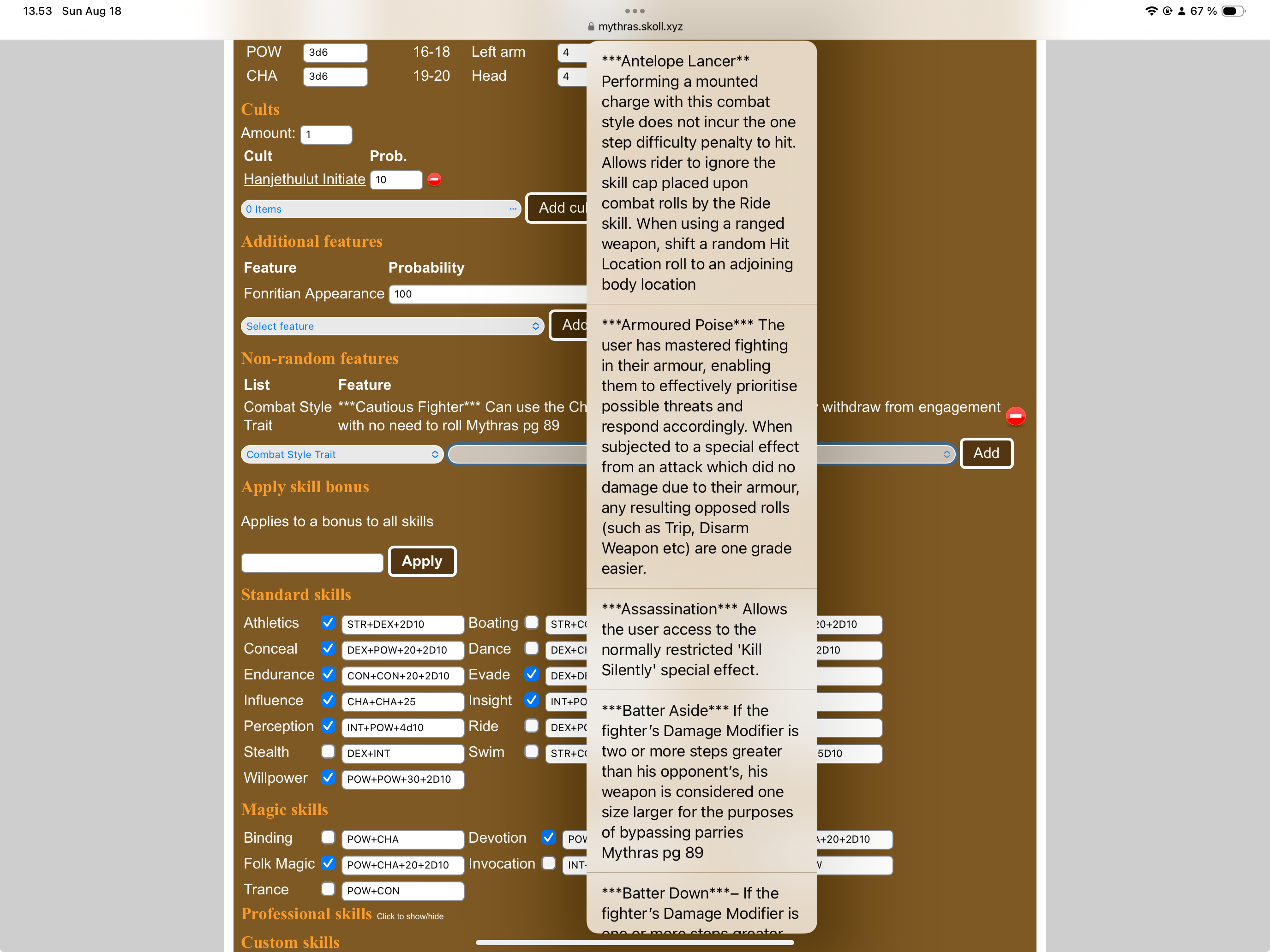
I added to the Combat Style Trait selection 80+ Combat Style Traits bring the whole number of selectable Combat Style Traits to be 135+ when you create or update your enemy. This should now contain pretty much all the Combat Style Traits published and a few campaign specific ones. You can select the combat style trait to be used like in the below picture
UPDATE: Divided the Combat Traits into subcategories:
Combat Style Traits – Close Combat
Combat Style Traits – Formation
Combat Style Traits – Mounted
Combat Style Traits – Ranged
Combat Style Traits – Unarmed
to make it easier to select from the long list of traits.
Here is a list of Sorcery Spells for Mythras. You need to go to appropriate reference tome to see the description and details of the spells so you need to own those reference tomes to go into detail.
This first version contains theist spells from RAW rulebook, Thennla books, Fioricitta, Book of Schemes, Fenix papers and Assabian Rites.
The list has now around 175 spells when counting also the few overlapping versions
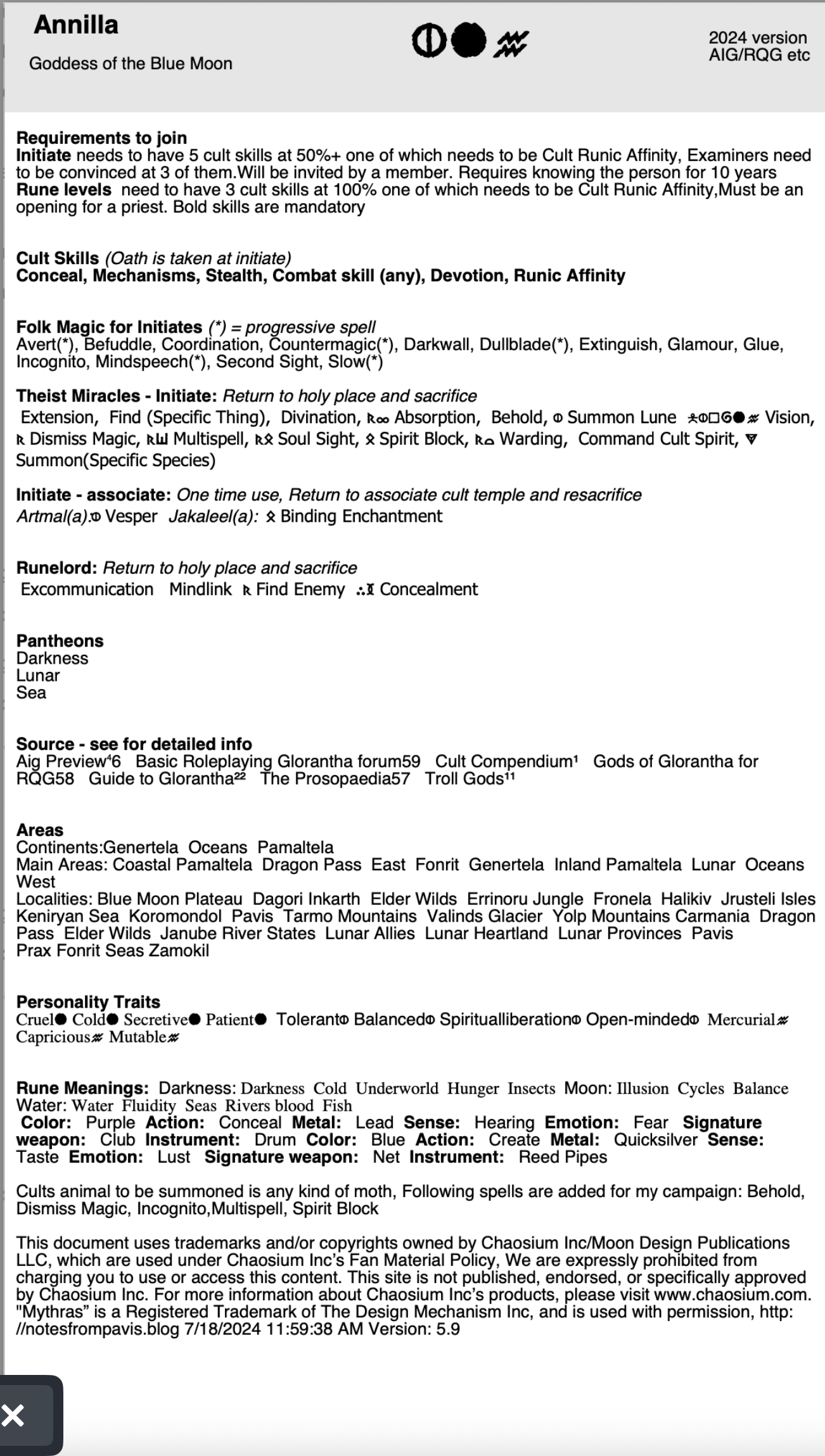
There is a new version of Annilla that has taken into account the current understanding of what the cult has. In RQG there would be no MindLink or Mindspeech as they are embedded into the system there. I also added some spells (with a note which I added at the bottom) that I thought would be useful for what the cult presents.
Here is a list of Folk Magic Spells for Mythras. You need to go to appropriate reference tome to see the description and details of the spells so you need to own those reference tomes to go into detail.
This first version contains theist spells from RAW rulebook, AiG, Thennla books, Fioricitta, Book of Schemes, Fenix papers and couple I have adopted in addition from RQ Glorantha. The ranks and spell costs are in this version from AiG also for RAW spells.
The list has now around 130 spells when counting also the few overlapping versions between AiG and RAW.
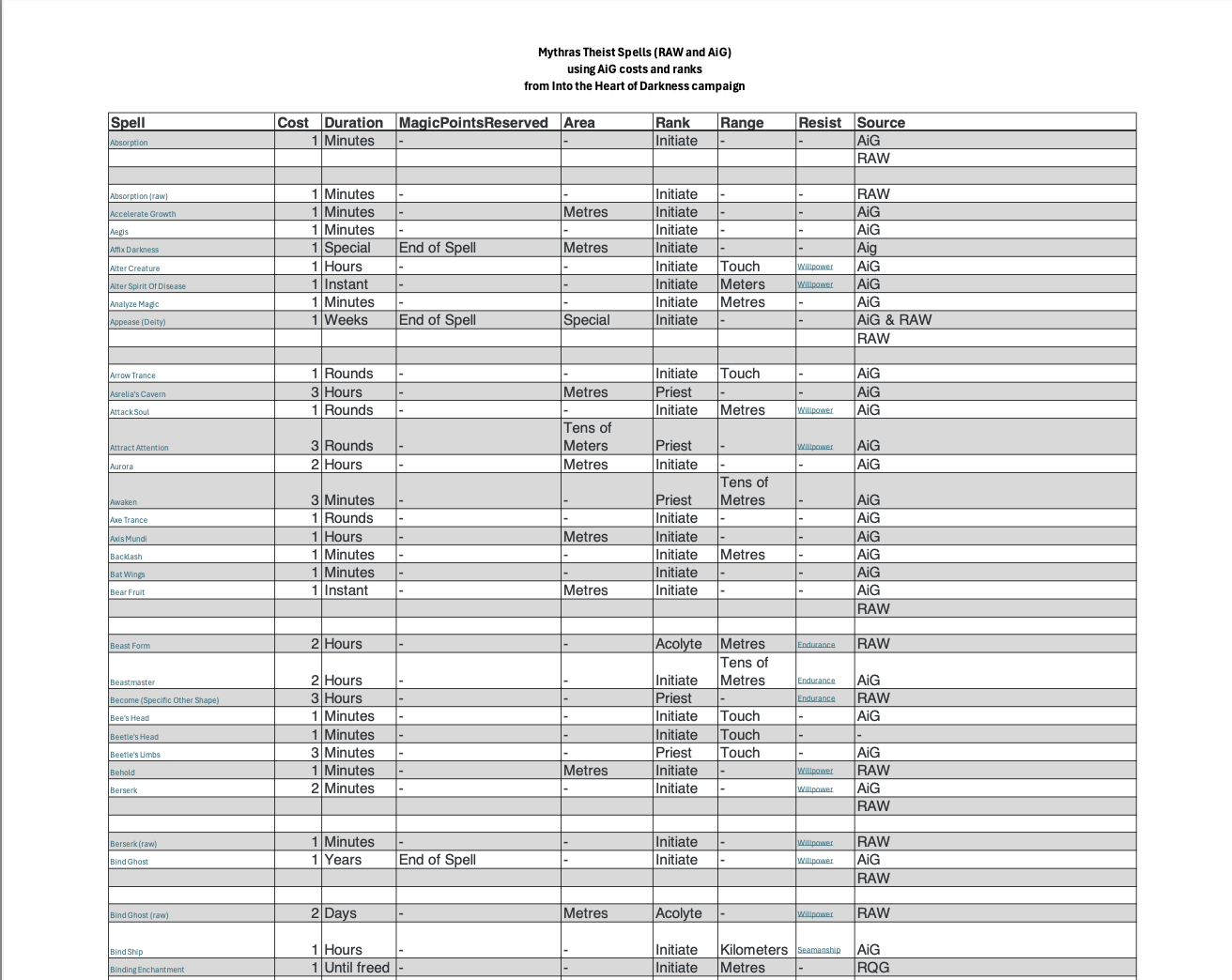
Here is a list of Theist Spells for Mythras. You need to go to appropriate reference tome to see the description and details of the spells so you need to own those reference tomes to go into detail.
This first version contains theist spells from RAW rulebook, AiG and couple I have adopted in addition from RQ Glorantha. The ranks and spell costs are in this version from AiG also for RAW spells.
The list has now around 430 spells when counting also the few overlapping versions between AiG and RAW.
Updated: There are now all the Theist spells mentioned in the grand index document included. This means Taskan Empire, Shores of Korentia, Sorandib and Fioricitta. In addition also Book of Schemes. It means 510 theist spells overall (with some overlap and small variations of some spells)
Here is a starter set of resources for a Mythras Player (not the GM). This is a subset of all resources available at NotesFromPavis blog plus additional cheatsheet by Duke Herb that I find useful
Book of Schemes by Dan True is a must addition to any GM’s toolbox for running Mythras. It joins my very short list of essential references alongside Monster Island. Book of Schemes concentrates on running a campaign in a city and brings alive a city that can be placed in a medieval or earlier campaign. More extensive review later on – there is loads of good stuff in the book.
Special effects get several new ones especially suited to city campaigns but useful also elsewhere.
Appeal to Reason
Force Opening
Glean Information
Nudge Opponent
Slam Location
Win Favour
I added the new special effects from the book to two of my GM and player charts. I will update the other charts later on.
My friend Antalon from the Mythras forums wrote an essay on how to be a great player in the Mythras roleplaying game. Here goes:
—-
I Game Master nearly exclusively. I am, however, a bad player. By this I mean that when I am let loose as a player, I just act an arse! Almost instinctively I look for ways to disrupt, betray and connive against my fellow players and the Game Master’s world, plot or adventure. (What inner trauma this reflects is for a different occasion!) As I consider my own behaviour, it got me thinking about how the players I have now, and over the years, have played at my table, especially with Mythras.
Some of my sessions in recent years have been nothing short of a triumph… so I’m a great Game Master then? No. There is a lot of discussion and advice ‘out there’ about what it takes to be a good – or great – Game Master. I’m firmly coming to the view that a Great Game is absolutely a collective effort: Great Players maketh the Game Master! Players have as much or maybe more responsibility for the success of the game as the Game Master – this is, if you look for it, well established advice. There is also a plethora of good player advice generally, essentially boiling down to respecting each other: don’t be an arse like me when playing!
So, how do we help players be great at Mythras specifically? Here, I set out my observations and preferences for player behaviour that mark the difference between a successful – that is, engaging, satisfying, surprising, dramatic, and funny – and unsuccessful game. My views also reflect recent experience with players that are new to Mythras, and fairly new to roleplaying in general. My hope is that I can improve my own behaviour as a player, whilst also easing the introduction to Mythras for others, and help players make their Game Master great!
In brief, players should:
Be driven, be passionate!
Play with the other players.
Focus on the described scene and their character motivations.
Enable other players to voice their action without undue debate or barracking!
Be driven, be passionate! The Passion mechanics are, technically, an optional rule. But just use them! Getting players to express what make’s their character tick, and what drives them to ‘adventure’, is the first ‘way in’ for a player and Game Master to know what the character and the game world is about. Playing to their passions makes the players invested in the game and makes decision-making much easier: passions ‘tell’ the player what actions or reactions ‘fit’ a situation.
Finding the right way to express the passion can be difficult. There are two ways around this. First, be flexible, and allow passions to be ‘re-expressed’ as the character’s personality solidifies in the player’s and gaming group’s mind. Second, set some thematic guidelines for choosing passions. Discuss what your table wants from the game and what is suitable to reflect the themes of the adventure or campaign setting. For example, for a Monster Island game I asked players to propose three passions based on an ambition or personal goal, a vice or dependency and fear or superstition. From this, across the players, I got “love to create mayhem”, to “total faith in Sarnai” (one of the other player characters), to “loyalty to companions” amongst others. This was not necessarily quite what I anticipated, but it got the players invested, started a discussion and, somehow, this eclectic mix of passions worked!
However, this experience of such varied passions made me conscious that care is needed to ensure passions are not too contradictory, either with each other or between different player characters. Passions could risk outright intra-party conflict. None of us want to condone the “that’s what my character would do” argument! Share choices of passions with the other players, and if they are not working, discuss it and fine-tune. However, there is a balance. Passions should – perhaps ‘must’ – aim for ‘dramatic tension’ between player characters: think about the best weekly TV drama, it is the tensions between the recurring characters that make it worth watching!
Play with the players. A feature of play nowadays is often reliance on video-calls or virtual tabletops. This has exacerbated the practical and real-world social difficulty many players face if – in character – they challenge or engage with each other’s characters. How many times have your players watched passively whilst another player declares – unilaterally – they are “stabbing the prisoner in the face”? This is not a Mythras-specific issue. But, the singular thing that moved my games from okay or good to Great was how, by mutual consent, players focused their attention on each other. In this way, they gave ‘permission’ for each other to respond to or interrupt one another’s actions. Sometimes the interruptions could not prevent an action occurring, but this fuelled the in-game drama. In this player-to-player focused game I found that I too, as Game Master, had ‘permission’ to invite interaction between players, to open opportunities for intra-party drama. It also shifted the focal point of attention from me as Game Master to a shared, inclusive, and animated dialogue. If players act true to their character’s passion where everyone feels welcome to respond to character action, then drama follows, and the game group reinforces positive engagement.
Focus on the described scene and your character motivations. The core mechanic of Mythras is a very simple ‘roll equal to or under’ on percentile dice. But system challenges do exist. Two examples are Mythras-centric: the expenditure and accounting of Action Points (especially combing with movement); analysis-paralysis of combat special effects. With modest effort a reasonable level of system-mastery can be achieved. But players do not need to master Mythras to be an excellent player! What players need to do is listen to the Game Master’s description of event, listen to other player’s choices and their descriptions, then describe what they – the player character – want to achieve and how this could happen. What the player wants to achieve is often informed by their passions. The Games Master’s job is then to translate, or suggest, how to reflect this action with game-mechanics. Focus on the drama and visceral responses, do not allow outcomes to be framed as an optimisation choice. New players in particular find it much easier to simply be narrative: “I leap forward and try to drive the bandit back with the savagery of my attack, I want to stop them threatening Sarnai who is trying to cast healing magic!”, which could be handled as a Press Advantage or Bash special effect. Surely all I’ve done is just describe roleplaying? Yes. But the art of listening and description is an art to be nurtured!
Enable other players to voice their action without undue debate or barracking! This is advice to me as a player and a Game Master. Having established ‘permission’ for player-characters to interrupt, this does not mean that you – as a player – should interrupt. When it is another player’s go, it is for them to state their action. Do not comment, criticise, suggest, scrutinise, analyse or otherwise pass judgement on another player’s choices. I realised what a difference this made when I noticed one of my groups patiently allowing each player to voice their actions on their turn without commentary. The outburst of the player that interrupts saying “No! You should do …” We did not debate this concord. It just happened. And I found that this simple act of respect for each other hugely strengthened trust between players, and the success of my game. It also facilitated in-character interruptions. To be clear, I do not intend that your character passively accepts the actions or consequences of another player-character, remember play with the players and be passionate. The desperate cry of “No!” invites a response between players: “I stab the bandit in the face anyway, and then grin savagely at Sarnai!”. Or, a player shouts-out to the Games Master “Wait, Layla needs to stop this!”, leading to an adjudication of the drama between characters (“Okay, make an Opposed Combat Style roll, if you beat Muammar, then you managed to parry his stab to the bandit’s face!”). But, what if a player asks for advice? In this case, wherever possible, describe your own character’s perspective and their motivations: “what special effect is best?”… “Well, Layla wants to get out of the fight quickly, so she would want you to help us escape… what could you do to help?”. Questions on the rules should be answered by the Game Master.
So, in the end, I’m not sure if this is really very Mythras specific? But, it does not matter. I think these are the things that I should do when playing. I want my players to do this, as it will make my games successful. Our shared responsibility, as players and Game Master, is to make the game a success. Whenever I play, this is how I think I can contribute to that goal.
Here is a Mystic order I did for my character in my friend Antalon’s campaign – Ormsfell Range.
Order of the Claws of the Dragon
Martial school of mysticism – Dragons in human form
Mythos and History
The Order of the Dragon’s Claw has an ancient and revered history steeped in the pursuit of Draconic Knowledge. Founded as a martial school of mysticism, this organization embarked on a quest to harness the hidden wisdom of dragons. Their journey began with the discovery of a cryptic Draconic script, a language believed to contain the very essence of dragons.
There are areas in the document that current wisdom in the cult cannot decipher or might have gotten wrong due to misinterpretations thruout past 1000 years or that are deeper mysteries known at higher levels in order or a bad combination of above
The order’s founders unearthed a profound method that involved the emulation of dragons in human form through the acquisition of Draconic Knowledge in the script, strict physical regimen and mystic enlightenment. They recognized the importance of Dragon’s Claws, the embodiment of the dragon’s strength, and a strict physical regimen to unlock their true potential. This revelation became the cornerstone of their mission: to become as dragons in human guise and safeguard the ancient secrets of Draconic Knowledge.
Nature
The Order of the Dragon’s Claw is deeply woven into the fabric of society, playing a colorful and meaningful role that extends beyond their mystical pursuits. They are renowned for their commitment to the protection of knowledge and their unwavering loyalty to those they serve.
In addition to their scholarly and martial pursuits, the order has become known for training trustworthy bodyguards, offering their services to protect scholars, nobles, and leaders who seek their assistance. This unique connection to society allows them to make a significant impact despite their relatively small numbers. They are sought after for their integrity, discipline, and their unwavering dedication to safeguarding their charges.
Who Can Join
Membership in the Order of the Dragon’s Claw is not open to all. Potential initiates must meet specific and demanding criteria to be considered:
– A deep-seated commitment to the preservation of knowledge and the pursuit of Draconic Wisdom.
– A willingness to undergo extreme physical and mental testing, demonstrating their resilience and ability to survive the path to emulate dragons in human form.
– Proficiency in martial and mystical disciplines, showcasing their dedication to the order’s ideals.
– A proven ability to keep the order’s secrets and uphold its values.
Joining the cult
For those who are deemed worthy and successfully initiate into the Order of the Dragon’s Claw, their journey is marked by several significant milestones:
1. Initiation: Initiates undergo a solemn initiation ceremony, where they take the Oath of the Claw, pledging their dedication to the order’s mission and values.
2. Extreme Training Regimen: Joining the cult means embarking on an arduous and relentless training regime that encompasses physical, mental, and mystical aspects. This includes mastering the Path of the Dragon combat style, deciphering the Draconic script, and honing their connection to Draconic Knowledge through extreme physical and mental tests.
3. Progression: Members advance through the ranks from Aspirant to Sage, with each level unlocking new insights, abilities, and responsibilities. Each step of the journey is marked by even more demanding tests of endurance and dedication.
4. Ongoing Service: Joining the cult means a lifelong commitment to the order’s cause, which includes the protection of knowledge, the acquisition of Draconic Knowledge, and the offering of their skills as bodyguards when called upon.
5. Access to Mysteries: As members progress, they gain access to the inner mysteries of the order, including unique gifts and abilities associated with Draconic Knowledge.
Consequences of leaving or betraying the organization
Leaving the Order of the Dragon’s Claw is a choice that comes with consequences, as the knowledge they possess is both a gift and a responsibility. Apostates are encouraged to tread cautiously, for the path they leave behind may lead to unforeseen challenges. The organization, however, does not view them as adversaries, understanding the complexity of their decisions.
Organization
– The Awakening of Scales: An annual event celebrating the order’s founding, marked by rituals that pay homage to dragons.
– The Claw’s Ascension: A ceremony where members reflect on their progress toward emulating dragons.
– The Dragon’s Breath: A meditation retreat where members seek to connect with the essence of dragons.
Ceremonies of the organization
– Dragonfire Offering: Members make symbolic offerings to honor dragons and seek their blessings.
– Rune of the Wyrm: Inscriptions of Draconic runes on weapons and armor, a protective and empowering ritual.
– Oath of the Claw: A solemn pledge, taken by new members, to uphold the values and goals of the order.
Organisation Home Base
– The Wyrm’s Sanctum: A hidden monastery nestled in the heart of remote mountains, where the deepest teachings are imparted.
– The Scales’ Repository: A treasury of ancient scrolls and tomes containing knowledge about Draconic script and lore.
– The Dragon’s Roost: A temple in a bustling city, serving as the public face of the organization.
Areas associated with organisation
– The Ormsfell Mountains: A range known for its dragon legends, where the order hopes to conduct new research and seeks mystical sites.
– The Library of Wyrm’s Wisdom: A repository of ancient scrolls and texts, carefully guarded by the order.
– The Temple of the All-Knowing: A place of worship and reflection, maintained and protected by the order.
Known members of the cult
Vestio – Follower of the Dragon. Exceptionally fit member of the order unwaveringly dedicated to the order and its mission with a fear of illness getting in the way of progression in the order.
Ignacio Kharma – Claw of the Dragon at Dragon’s Roost, Vestio’s rival within the order with uncanny ability to manipulate people.
Master of the Stick – Highest ranking member of the order at the Dragon’s Roost temple.
Membership
Standard
Ranks
Aspirant
Follower of the Dragon
Claw of the Dragon
Master
Living Dragon
Members often adopt names inspired by dragons or their attributes, a testament to their commitment to Draconic Knowledge.
Restrictions
Members are encouraged to collaborate and share their findings within the cult, avoiding any restrictions on revealing their knowledge.
Tradition: uses only weapons and armor made of wood, leather or dragon bone (it is just ordinary bone armor)
Can be used to present a particular aspect to those who behold him. Overcoming the mystic’s aura requires an opposed roll of Willpower versus the mystic’s Mysticism roll for invoking the trait. The aura affects all things within a radius of the mystic’s POW in metres.
Master
Invoke Pain Control
The mystic is inured to pain and able to work through its effects. Endurance rolls when experiencing any kind of injury are considered to be automatic successes.Has to accept a geas
Master
Special Effect Dragon’s Claw
Dragon’s Claw – May learn(5 XP) a new Special Effect called Dragon’s Claw that allows them to penetrate a number of points of worn or natural armor equal to 1/20th their Mysticism skill with their unarmed attacks using their cult combat style. They need to possess in their person a piece of a Dragon’s Claw to use this.
Master
Augment Insight
Needs to have Lore(How to be a Dragon) at 70. Needs to have a dragon scale to use the gift.
Breathing the smoke from a fire with the Drake Flower (have to find it first) 1MP per shot. Meditation roll required to succeed.
Each shot adds one difficulty grade. If fail then delirious for an 1d3 hours
1MP per hour if one has supply of Dragon Claws (at least x ENC present)
Gifts
Alacrity for Sage. Gifts associated with Draconic abilities and knowledge, granted as members progress in their pursuit of emulating dragons. First gift received as a respected master or sage
Return of the Magic
Consumption:
Breathing the smoke from a fire with the Drake Flower (have to find it first) 1MP per shot. Meditation roll required to succeed.
Each shot adds one difficulty grade. If fail then delirious for an 1d3 hours
1MP per hour if one has supply of Dragon Claws (at least x ENC present)
Gifts
Alacrity for Sage. Gifts associated with Draconic abilities and knowledge, granted as members progress in their pursuit of emulating dragons. First gift received as a respected master or sage
Divine Intervention
None
Allies and enemies
Friendly with the God of Knowledge, who appreciates their dedication to preserving wisdom.
Engaged in alliances and collaborations with various powers, depending on their goals and interests in acquiring Draconic Knowledge.




 Notes From Pavis